Understanding Child Tax Credit Eligibility Explained can feel confusing, especially with the major updates introduced in 2021. However, this credit can significantly reduce your tax bill—or even increase your refund. So, who qualifies? What income limits apply? And why is the SSN requirement so important?
In this guide, we break everything down in simple terms. Whether you’re filing taxes for the first time or optimizing your benefits, this article will help you confidently understand your eligibility.
Featured Snippet Answer (Quick Answer)
Child Tax Credit eligibility in 2021 depends on having a qualifying child under age 18, meeting income limits, and ensuring the child has a valid Social Security Number (SSN). The credit can be up to $3,600 per child, with phase-outs starting at specific income thresholds.
Table of Contents
- What Is the Child Tax Credit (2021 Update)?
- Qualifying Child Rules Explained
- Income Limits and Phase-Outs
- SSN Requirements You Must Know
- How to Claim the Credit
- Why It Matters
- Key Takeaways
- FAQs
What Is the Child Tax Credit (2021 Update)?
The Child Tax Credit (CTC) was expanded in 2021 under pandemic relief measures. It offered:
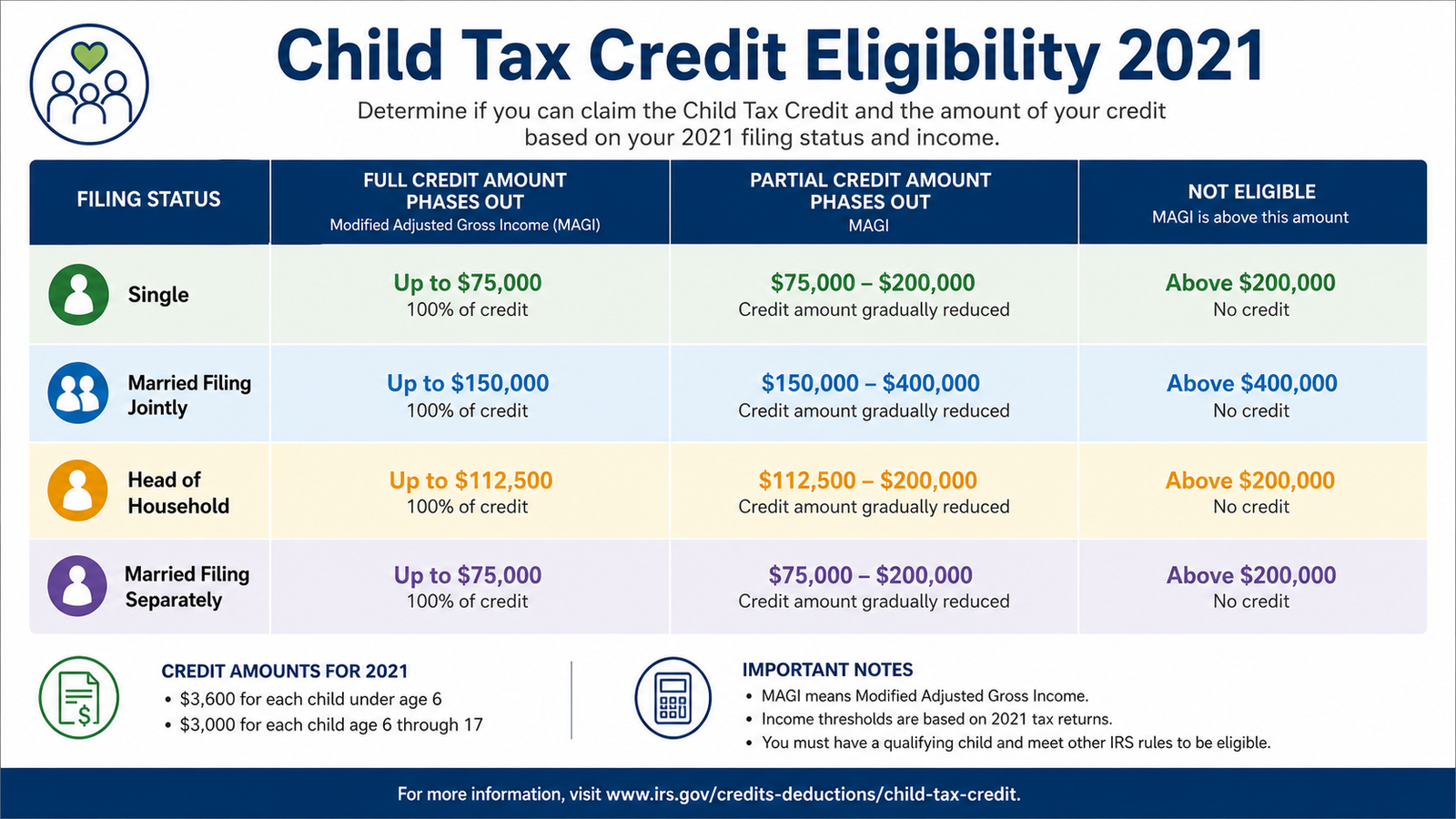
- Up to $3,600 per child under age 6
- Up to $3,000 per child aged 6–17
- Fully refundable benefits for many families
- Monthly advance payments (July–December 2021)
This made it one of the most valuable tax credits for families.
Qualifying Child Rules Explained
To meet Child Tax Credit eligibility, your child must satisfy the IRS “qualifying child” criteria.
Basic Requirements
Your child must:
- Be under age 18 at the end of 2021
- Be your:
- Son, daughter
- Stepchild or foster child
- Brother, sister, or descendant (like a grandchild)
- Live with you for more than half the year
- Be claimed as a dependent on your tax return
- Not provide more than half of their own support
Residency & Relationship Tests
These tests ensure the child is genuinely dependent on you.
✔ Residency: Must live with you most of the year
✔ Relationship: Must be closely related
Income Limits and Phase-Outs
Income plays a major role in determining your eligibility.
Full Credit Income Thresholds
You qualify for the full credit if your income is below:
| Filing Status | Income Limit |
|---|---|
| Single | $75,000 |
| Head of Household | $112,500 |
| Married Filing Jointly | $150,000 |
Phase-Out Rules
- The enhanced credit ($3,000/$3,600) begins to reduce above these limits.
- The standard $2,000 credit phases out at:
- $200,000 (single)
- $400,000 (married filing jointly)
Example
If you earn $160,000 as a married couple, your enhanced credit will reduce gradually—but you may still qualify for a partial benefit.
SSN Requirements You Must Know
One of the most critical factors in Child Tax Credit eligibility explained is the SSN requirement.
Key Rules
- The child must have a valid Social Security Number (SSN)
- The SSN must be issued before the tax return due date
- ITIN (Individual Taxpayer Identification Number) does NOT qualify
Why This Matters
Without a valid SSN, you cannot claim the Child Tax Credit—even if all other conditions are met.
How to Claim the Child Tax Credit
Claiming the credit is straightforward if you meet all criteria.
Steps to Follow
- File your federal tax return (Form 1040)
- Include Schedule 8812
- Provide accurate child details (SSN, age, dependency)
- Reconcile advance payments (if received)
Why It Matters (Google Discover Optimization)
The Child Tax Credit is more than just a tax benefit—it’s financial support for families.
Quick Insights
- Many families received monthly payments in 2021
- It helped reduce child poverty rates significantly
- Missing eligibility rules can cost you thousands of dollars
Understanding these rules ensures you don’t leave money on the table.
Key Takeaways
- Child Tax Credit eligibility explained depends on age, relationship, income, and SSN
- Maximum credit: $3,600 per child (2021)
- Income limits determine how much you receive
- SSN is mandatory—no exceptions
- Proper filing ensures you receive the full benefit
Conclusion
Understanding Child Tax Credit eligibility explained is essential if you want to maximize your tax benefits. From qualifying child rules to income limits and SSN requirements, every detail matters.
If you meet the criteria, this credit can provide significant financial relief. Don’t miss out—review your eligibility carefully and file your taxes accurately.
FAQs
1. Who qualifies for the Child Tax Credit in 2021?
Parents with a qualifying child under 18, meeting income limits and SSN requirements, qualify.
2. What happens if my income exceeds the limit?
Your credit amount reduces gradually but may not disappear entirely.
3. Can I claim the credit without an SSN?
No, a valid SSN is mandatory for the child.
4. Is the Child Tax Credit refundable in 2021?
Yes, it was fully refundable for most taxpayers in 2021.
5. Do I need to repay advance payments?
Possibly, if your income increased or eligibility changed.